In every organization, managers face the same silent battle: trying to lead teams, meet deadlines, and maintain quality—while drowning in constant urgency. Emails, meetings, reports, and firefighting become the daily routine. Progress feels like running on a treadmill: full of motion, yet going nowhere.
But the truth is simple managers don’t fail because they lack skill; they fail because they operate without a mental model.
What they need is not more hours, but better frameworks.
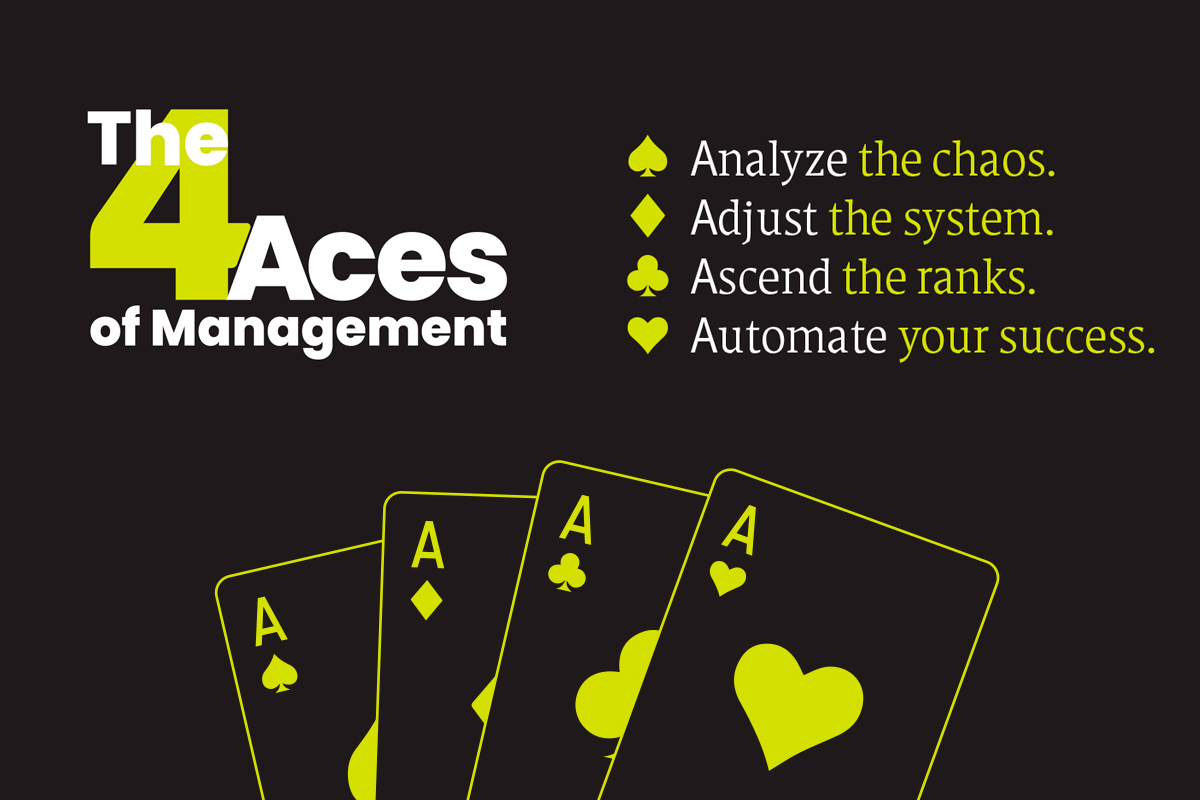
This is where the 4 Aces of Management come in a leadership philosophy designed to help professionals rise from reactive management to proactive mastery.
Taken from the core teachings in The 4 Aces of Management: Analyze, Adjust, Ascend, Automate, this framework provides a practical roadmap for building clarity, direction, and autonomy inside teams.
Ace 1: ANALYZE — The Power of Awareness
Every successful leader begins with a simple but rare skill: the ability to see clearly.
Most managers jump to solutions without understanding the problem. They operate on assumptions, personal bias, or past experience.
But observation not authority is the foundation of leadership.
Great managers “see before they solve.” They slow down, understand the patterns beneath performance, gather facts, and listen before acting. They use tools like SWOT analysis, 5 Whys, and observation grids to uncover root causes rather than treating surface symptoms.
Awareness turns confusion into clarity—and clarity drives intelligent action.
Ace 2: ADJUST — The Science of Correction
Once awareness is established, great managers move to refinement.
But here lies a universal truth:
Most managers fear correction—not because change is hard, but because admitting something isn’t working feels personal.
The second Ace teaches leaders to embrace course correction not as failure, but as evolution.
Through structured systems like the PDCA loop (Plan–Do–Check–Act), leaders learn to experiment, test, tweak, and improve. Instead of sweeping mistakes under the rug, they refine processes with emotional intelligence, transparency, and maturity.
Adjustment transforms mistakes into momentum.
Ace 3: ASCEND — From Manager to Mentor
You cannot scale a team by controlling everything.
You scale by growing people.
The third Ace shifts leadership from authority to empowerment:
- Delegating without fear
- Creating leaders instead of dependents
- Building confidence, not compliance
- Trusting people with responsibility, not just tasks
A team that is empowered becomes self-sustaining. Decisions happen faster. Innovation rises naturally. Ownership becomes cultural.
When leaders ascend, they lift others with them and the entire organization transforms.
Ace 4: AUTOMATE — Systems That Create Freedom
The final stage of leadership mastery is autonomy.
At this level, leaders no longer run behind tasks. They build systems workflows, dashboards, SOPs, and frameworks—that keep the organization functioning smoothly without constant supervision.
Automation is not about replacing humans; it’s about freeing them.
It enables managers to:
- Focus on strategy instead of daily pressure
- Build self-correcting systems
- Create workflows that scale
- Turn data into decision-making tools
When automation meets empowerment, teams operate like well-designed machines: adaptive, fast, and reliable.
This is the stage where leadership becomes legacy.
Why the 4 Aces Matter Today
In a world that changes faster than ever, old management styles no longer work.
Command-and-control leadership collapses under complexity.
The new age of leadership demands:
- Clarity instead of chaos
- Systems instead of stress
- Meaning instead of maintenance
- Empowerment instead of authority
The 4 Aces provide a timeless, repeatable structure for that transformation helping managers evolve into architects of performance, culture, and growth.
Final Thought: Leadership Is Not Firefighting—It’s Design
Organizations do not fail because of bad people.
They fail because of blind systems.
The 4 Aces awaken a simple but powerful idea:
You can’t lead what you can’t see. You can’t scale what you can’t systemize. And you can’t elevate others until you elevate your own mindset.
When leaders Analyze, Adjust, Ascend, and Automate, they don’t just control outcomes; they design them.
And that is the difference between managing a team and mastering leadership.