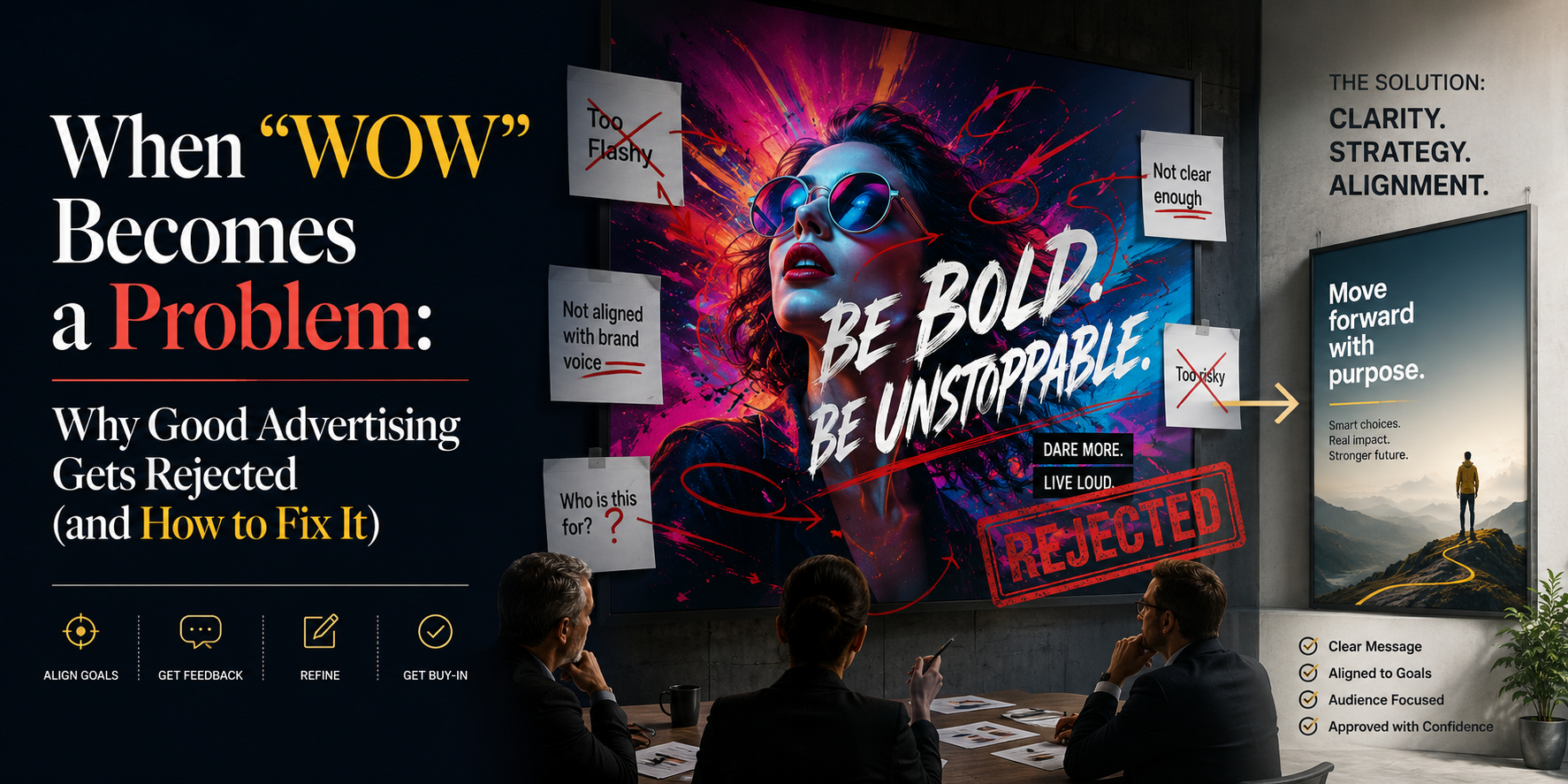
It usually starts with a simple request.
The client says, “We want something WOW. Something innovative, powerful, impressive.”
The agency nods. The team begins.
They do everything right. They study the business. They analyze competitors. They define the target audience. They identify the unique selling propositions. They think deeply. They build a campaign rooted in logic and insight.
They present the work.
And it gets rejected.
“It’s too subtle.”
“It feels generic.”
“Look at competitors — they are doing something stronger.”
The team goes back. Revises. Pushes harder. Adds more energy, more elements, more noise.
Another presentation. Another rejection.
This cycle repeats.
Frustration builds. Confidence drops. Conversations become defensive. Deadlines shrink. And slowly, the relationship weakens.
Eventually, the business is lost.
The Real Problem (That No One Talks About)
At first glance, it looks like a creative failure.
It isn’t.
The real problem is misalignment disguised as feedback.
The client believes they gave a clear direction. The agency believes it followed it correctly. But both are working with different definitions of the same words.
“WOW” to the client might mean bold, loud, and attention-grabbing.
“WOW” to the agency might mean insightful, sharp, and strategically sound.
Both are valid.
But without alignment, both are wrong.
This is where things break.
The agency builds based on what should work.
The client evaluates based on what feels right.
And those two worlds rarely meet on their own.
Why Rejection Keeps Happening
Because the brief was never truly clear.
Words like innovative, powerful, and impressive are not directions. They are interpretations. They create the illusion of clarity while leaving space for multiple meanings.
What makes it worse is comparison.
The client doesn’t just evaluate the work against the brief — they compare it with competitors. Suddenly, the goal shifts. It is no longer about solving a business problem. It becomes about matching or outperforming what already exists.
The agency tries to differentiate.
The client tries to relate.
And in that gap, the idea collapses.
The Turning Point
At some stage, the agency realizes something uncomfortable.
They did not fail at execution.
They failed at alignment.
They solved a problem that was never clearly defined.
And no matter how refined the work becomes, it will continue to be rejected — because it is answering the wrong question.
The Solution: Define Before You Design
The only way out of this cycle is to fix the starting point.
Before any copy is written. Before any design is created. Before any campaign is imagined — clarity must be established.
Not broad clarity. Not emotional clarity.
Operational clarity.
Start with simple, but precise questions.
What exactly should this campaign achieve?
Who is the audience, and what should they feel?
At what moment should the impact happen — first glance, engagement, or conversion?
Do we want to stand out or align with market expectations?
What does “success” look like in one sentence?
And most importantly:
What does “WOW” actually mean in this context?
When these answers are agreed upon, creativity becomes focused. Decisions become faster. Feedback becomes constructive. Rejections reduce — not because ideas are weaker, but because expectations are clearer.
A Better Way to Work
Great campaigns do not start with copy.
They do not start with design.
They start with shared understanding.
When the agency and client agree on what they are trying to achieve, creativity becomes a tool — not a gamble.
The team stops guessing.
The client stops comparing.
The work starts progressing.
Conclusion
Advertising is often seen as a business of ideas.
But in reality, it is a business of decisions.
And when decisions are unclear, even the best ideas fail.
Most rejected campaigns are not bad campaigns.
They are misaligned campaigns.
Because in the end:
“WOW” is not a brief. It is a symptom of a missing one.
Fix the brief, and you fix the outcome.
Everything else is execution.