What a 17th-Century Swordsman Who Never Lost a Duel Can Teach You About Leadership
Three hundred years before your last performance review, a man who had never lost a single duel sat alone in a cave and wrote down the only twenty-one sentences he thought were worth leaving behind. No sword techniques. No secret combat moves. Just twenty-one brutally honest rules for how to think, how to decide, and how to live without lying to yourself.
His name was Miyamoto Musashi. And if you lead a team, run a business, or make hard calls under pressure, what he wrote is more relevant to you today than it ever was to the samurai who first read it.
The Boy Who Learned Clarity the Hard Way
Musashi was born around 1584, into a Japan that was not calm, not ordered, and not forgiving. It was a land held together by fragile alliances and sudden betrayals, where one miscalculation could end your life and your family’s future in the same afternoon. He is said to have fought his first duel at the age of thirteen. While most of us were worrying about homework at that age, Musashi was already testing whether he would live or die based on nothing but his own skill, focus, and nerve.
He never settled into a comfortable position under one master. He became what was called a ronin, a masterless samurai. No steady salary. No guaranteed backing. No safety net of any kind. His only security was his sword, his mind, and his ability to adapt faster than the person standing across from him.
Over the years, he is reported to have fought more than sixty duels. He was never defeated. Not once.
Here’s the part worth sitting with: it wasn’t raw talent that kept him alive that long. It was the ruthless way he eliminated everything unnecessary from his thinking. No ego clouding his judgment. No wishful thinking softening hard truths. No excuses when something went wrong. Just clarity, and the discipline to act on that clarity immediately.
Musashi fought at the Battle of Sekigahara, one of the most important battles in Japanese history, while he was still very young. Imagine standing in the middle of that, watching entire armies collide, knowing one mistake could end not just your life but your entire clan’s future. That is not the kind of environment that allows for illusion. It strips illusion away completely. It taught Musashi something he carried for the rest of his life: ego, denial, and wishful thinking get people killed. Clarity does not.
Later, he developed his own style of swordsmanship using two swords at once, but the real innovation was never really about the blades. It was mental. He studied timing. He studied distance. He studied how opponents breathed, how they hesitated, how they postured to hide fear. He understood, long before modern psychology gave it a name, that most confrontations are decided in the mind before the first move is ever made. Sound familiar? It should. That’s every negotiation, every board meeting, every tense conversation with a client who’s about to walk, decided before a word is even said.
The Cave, and the Twenty-One Lines
Near the end of his life, after decades of combat, travel, and teaching, Musashi withdrew to a cave called Reigandō. It was there that he wrote his most famous work, The Book of Five Rings, a manual of strategy that has since been studied not only by warriors but by business leaders, entrepreneurs, and strategists all over the world.
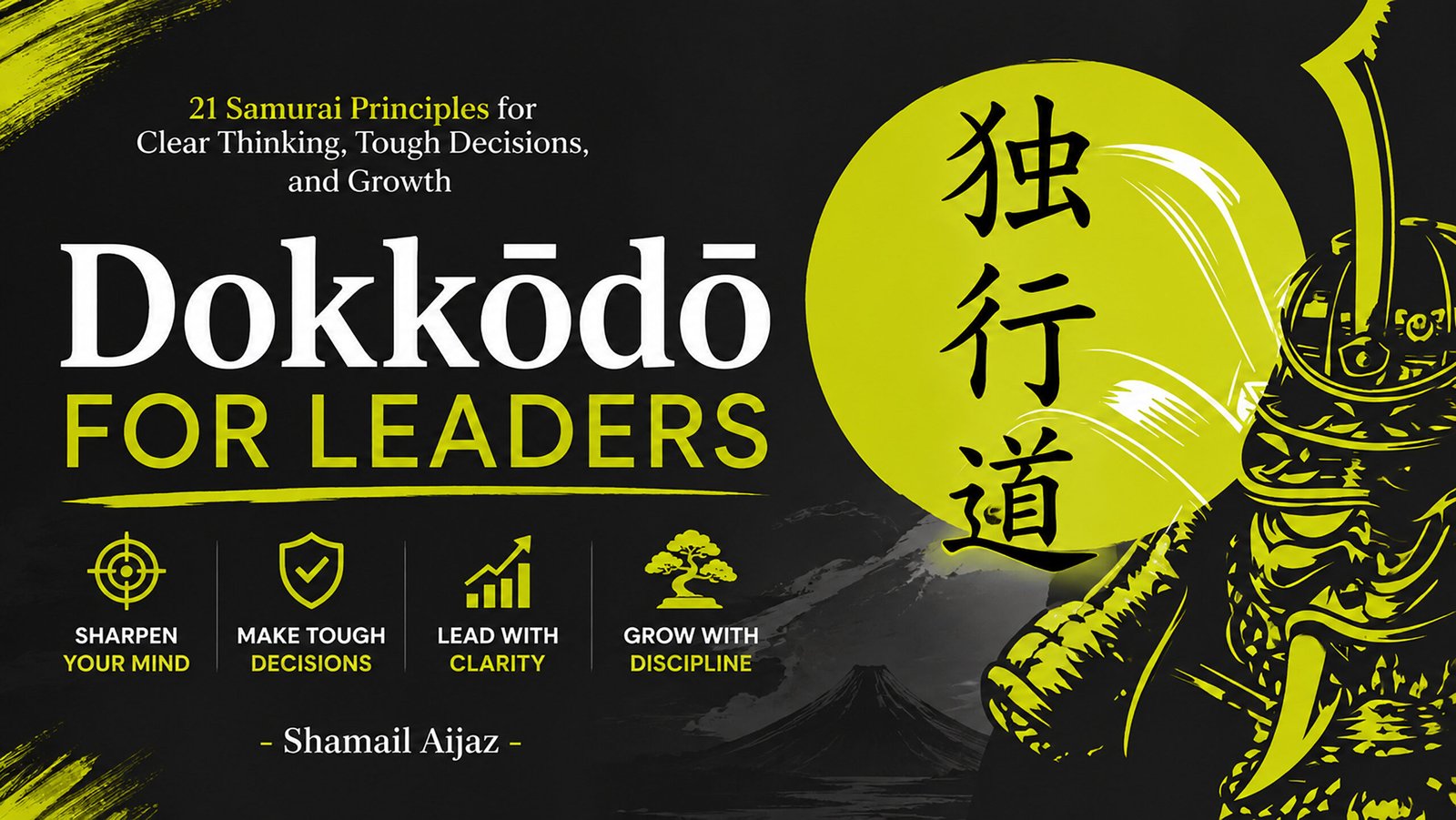
But in that same period, he also wrote something much shorter, much quieter, and in some ways far more personal. It was called Dokkōdō, “The Way of Walking Alone.” Unlike The Book of Five Rings, which is about strategy and combat, Dokkōdō is about how to live. It is a list of twenty-one rules, the final, distilled essence of a man who had already seen everything life could throw at him: victory, loss, fame, solitude, and had reduced it all down to what actually mattered.
He didn’t write it for an army. He wrote it for himself, and for one trusted student he handed it to before the end of his life. Twenty-one lines. No decoration, no padding, nothing wasted. Call it the final software update of a warrior who had spent his entire life debugging his own mind.
From the Battlefield to the Boardroom
Here’s the question this book is built around: what happens when you take those twenty-one lines out of feudal Japan, out of the swords and the battlefields, and place them directly into your boardroom, your inbox, your next difficult conversation with your team? What happens when a four-hundred-year-old code written by an undefeated warrior becomes a working manual for modern leadership?
That’s exactly what Dokkodo for Leaders does. It’s not a history lesson, and it’s not a collection of vague inspirational quotes stretched across pretty pages. It takes each of Musashi’s twenty-one rules and rebuilds it for the world you actually operate in — a world of markets that shift overnight, teams that need honest leadership instead of comfortable illusions, and decisions that never wait around for perfect information.
Here’s a glimpse of what’s waiting inside, without giving away the parts you need to sit with yourself.
Rule One, Accept Reality: Clear-Sighted Leadership, opens the book by confronting the single habit that quietly destroys more companies than bad luck ever will — believing what you want to be true instead of what the numbers are actually screaming at you.
Rule Two, Beyond Pleasure: Discipline in Business, moves into the discipline that has nothing to do with willpower and everything to do with refusing short-term comfort for long-term strength.
Rule Three, Avoid Partial Feelings: Data-Driven Judgment, takes on confirmation bias directly — the blind spot every leader protects without realizing it.
Rule Four, Think Lightly of Yourself: Ego-Free Leadership, has nothing to do with low self-worth and everything to do with ego as the enemy of innovation. You’ll see exactly how ego quietly poisons decision-making long before anyone notices the damage.
Rule Five, Detachment From Desire: Strategic Unattachment, is where things get uncomfortable in the best way. Your emotional attachment to old plans, sunk costs, and products you built with your own hands will keep you loyal to a losing position long after the evidence says otherwise.
Rule Six, No Regret, Only Reflection: Fail Fast, Learn Fast, hands you a practical approach to treating failure as data instead of identity.
Rule Seven, Without Jealousy: Eliminating Office Politics, digs into loyalty and transparency versus competition dressed up as teamwork.
Rule Eight, Separation Without Sadness: Letting People Go Gracefully, handles something almost no leadership book addresses honestly — that firing someone doesn’t have to be treated as failure or as cruelty.
Rule Nine, No Complaints, No Blame: Extreme Ownership, breaks down what it actually costs a team when leadership models excuse-making instead of accountability.
Rule Ten, Control Desires: Emotionally Intelligent Leadership, deals with keeping emotion from clouding decisions and avoiding the favoritism that destroys trust inside a team without anyone naming it out loud.
Rule Eleven, No Preferences: Adaptability as Competitive Advantage, is about holding strong opinions loosely — and why the businesses that survive market shifts are almost never the ones that were the most rigid.
Rule Twelve, Indifference to Place: Remote Leadership and Global Thinking, turns Musashi’s idea of indifference to location into a genuinely useful lens for anyone leading a distributed team across time zones today.
Rule Thirteen, Beyond Good Food: Avoiding the Comfort Trap, and Rule Fourteen, Minimal Possessions: Lean Business Operations, work as a pair — one on why comfort is one of the most dangerous states a growing organization can settle into, the other on cutting operational waste and staying nimble.
Rule Fifteen, Not Following Customs: Innovating Beyond Norms, walks through first-principles thinking and real case studies of companies that broke the rules everyone assumed were fixed.
Rule Sixteen, Only Useful Weapons: Strategic Focus, is about avoiding “tool addiction” — chasing every new trend, every shiny platform, every distraction disguised as innovation.
Rule Seventeen, Fearless Leadership: Executing Under Pressure, is built entirely around courage, and how the leaders who move through crisis instead of freezing in it separate themselves permanently from everyone else in the room.
Rule Eighteen, No Greed for Old Age: Avoid Hoarding for Security, challenges the instinct to stockpile out of fear instead of reinvesting in what comes next.
Rule Nineteen, Respect Without Reliance: Self-Reliant Leadership, is about preparing for opportunity instead of waiting for luck, and building systems instead of hoping things simply work out.
Rule Twenty, Honor Over Comfort: The Samurai Leadership Code, gets into what it actually means to build organizational integrity and trust as a real business asset, not just a value statement printed on a wall somewhere.
And Rule Twenty-One, Never Stray from the Way: Creating Your Leadership Path, closes the book with what might be the single most important idea in the entire text — defining your own leadership code and staying aligned with who you are even when everything around you is in chaos.
Why This Book Isn’t Like the Others
Most leadership books are written by people who have never had to make a decision where the outcome actually cost them something real. This one is different, because the man behind the philosophy staked his literal life on every principle he lived by, sixty times, without ever losing. That’s not a marketing angle. That’s the reason these twenty-one rules have survived four hundred years instead of fading into forgotten history like almost everything else written in that era.
By the time you finish Dokkodo for Leaders, you’re not just understanding a four-hundred-year-old warrior’s philosophy. You’re building what Musashi called his Way — your own leadership code, one that doesn’t bend the moment real pressure shows up.
So ask yourself honestly. Have you ever walked out of a meeting knowing you compromised on something you shouldn’t have? Have you ever made a decision out of fear instead of clarity? Have you ever wondered what it would actually take to lead the way Musashi fought — undefeated, unshaken, and completely uncompromising?
If any part of that just landed, this book was written for exactly that moment in your career.
Dokkodo for Leaders is available now on Amazon.
Twenty-one rules, tested in blood and refined over a lifetime, translated for the boardroom instead of the battlefield. One path. Your Way.